
Northrop Grumman Compact CEESIM-VPX HF-Signalsimulator
Northrop Grumman Compact CEESIM-VPX RF Signal Simulator
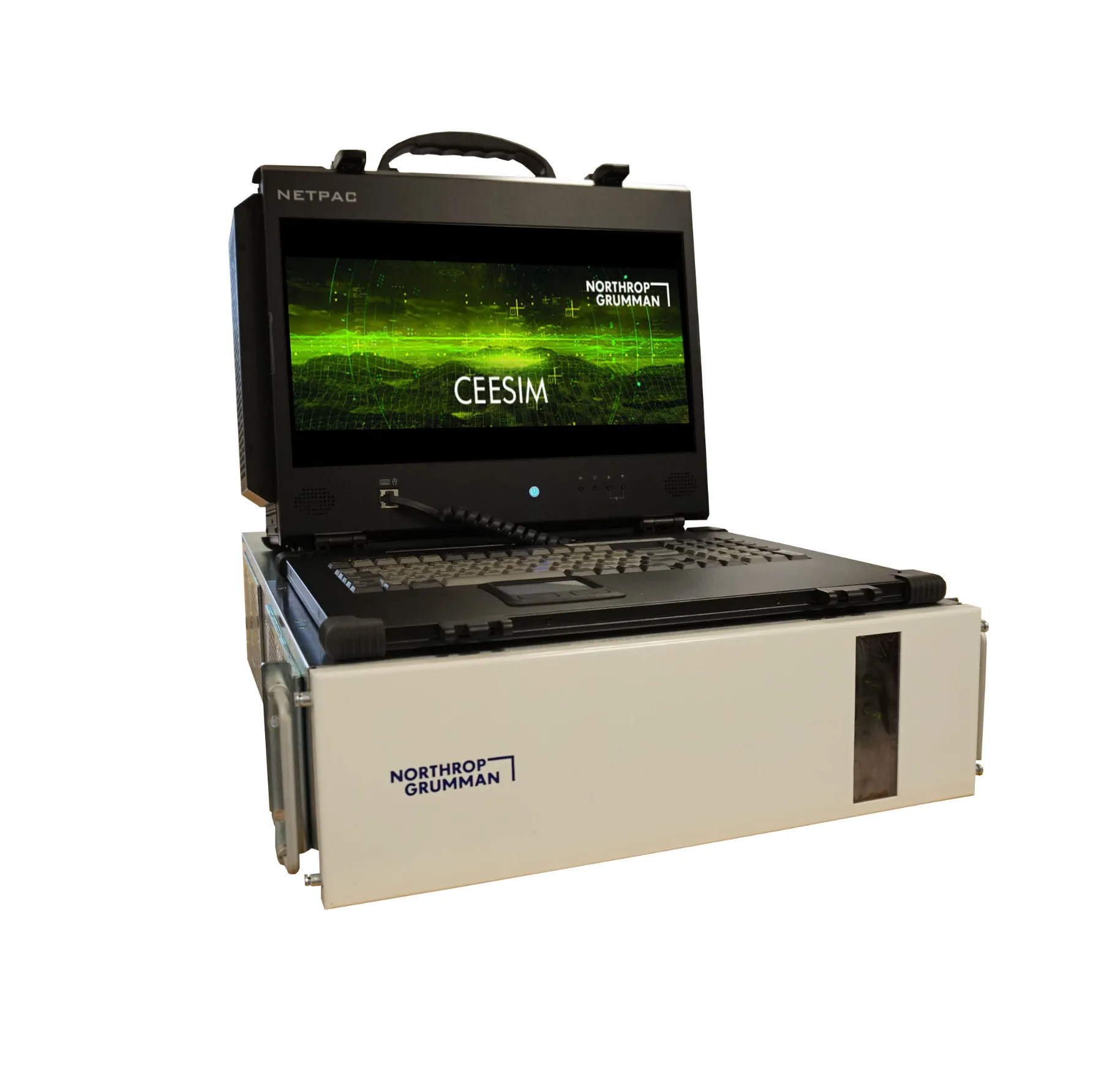
Northrop Grumman Compact CEESIM-VPX ist ein HF-/EW-Bedrohungssimulator mit 20 MHz bis 40 GHz Frequenzbereich, DDS-Synthese, hochwertige Signalerzeugung und vollständige CEESIM-Systemkompatibilität.
Produktdetails
| Modell | COMPACT CEESIM-VPX |
| Hersteller | Northrop Grumman |
| Kategorie | HF- und Mikrowellensignalgeneratoren |
| Verfügbarkeit | Auf Anfrage |
Beschreibung
Übersicht
Der Northrop Grumman Compact CEESIM-VPX ist ein kostengünstiger HF-/EW (Elektronische Kriegsführung)-Bedrohungssimulator für Tests und Validierung von hochentwickelter Elektronische-Kriegsführungs-Ausrüstung. Basierend auf bewährter Vollgröße-CEESIM-Technologie bietet die kompakte VPX-Konfiguration hochwertige HF-Signalerzeugung über einen breiten Frequenzbereich mit kleinem Platzbedarf für Labortisch- und mobile Testumgebungen einschließlich anechoischer Kammern und Freiluftplätze.
Hauptmerkmale
- Frequenzabdeckung von 20 MHz bis 40 GHz mit 1 Hz Auflösung
- Direct Digital Synthesis (DDS) Frequenzsteuerung für genaue, flexible Signalerzeugung
- Hochwertige HF-Generierung mit komplexen Intra-Impuls-Modulationen
- Schnelle 0,5 Mikrosekunden-Abstimmungszeit für dynamische Szenarios-Tests
- Mehrere Strahler-Dichte bis zu 1 MPPS pro Kanal
- Phasenkohärenz über alle Strahler für synchronisierte Multi-Kanal-Operation
- Bis zu 2 GB MOP (Modulations-Operations-Muster)-Speicher mit externem Datenstreaming
- Vollständige Szenario- und Strahler-Kompatibilität mit Standard-CEESIM-Systemen
- Bewährte TRVAL-Validierung auf US-Verteidigungsprogrammen
- Optionale Ultra-Low-Band (ULB) und Millimeterwellen (MMW) Frequenzerweiterungen
Technische Möglichkeiten
- Frequenzgenauigkeit: ±2 Hz über alle Bänder
- Phasenrauschen bei 1 MHz Offset: -130 dBc/Hz (20 MHz–18 GHz), -125 dBc/Hz (18–40 GHz)
- Breitband-Rauschen: -85 dBc/MHz typischerweise über 20 MHz–40 GHz
- FM-Abweichung: ±500 MHz mit ±1% Genauigkeit
- Phasenmodulations-Auflösung: 1 Grad mit ±2 Grad Genauigkeit
- Maximale MOP-Abtastrate: 1280 MSPS für komplexe Wellenformenwiedergabe
- Keine erforderlichen Strahler-Kalibrierungen für schnelle Bereitstellung
Anwendungen
- Tests und Validierung von Elektronische-Kriegsführungs-Systemen
- Radar-Bedrohungssimulation und Strahler-Modellierung für Systemqualifikation
- Test-Unterstationen und SIL (Software-in-the-Loop) Umgebungen
- Tests in anechoischer Kammer und auf Freiluftplätzen für EW-Plattformen
- Integrationstests auf hochentwickelten US-Verteidigungsprogrammen
- Schnelle Prototypenfertigung und F&E für Bedrohungssignal-Generierung
Systemkonfigurationen
- Einzelkanal: 0,5–18 GHz mit einzelnem omnidirektionalen Ausgangsport
- Dualkanal: 0,5–18 GHz mit einzelnem omnidirektionalen Ausgangsport
- Erweiterte Frequenz: 20 MHz–40 GHz einzelner omnidirektionaler Ausgang (benötigt ULB/MMW HF-Slices)
- Fortschrittlicher Multi-Port: 0,5–18 GHz mit 4 Ports für Phase, Amplitude und TDOA Ausgänge
Technische Daten
| Low Cost/Quick Delivery | Cost is comparable to other commercial small simulators, but with all the power and capabilities of our full-sized CEESIM. Quick turn delivery is available. |
| Small Footprint | CCVPX provides the greatest flexibility and expandability of any small EW simulator available. What takes racks full of other suppliers’ hardware can be done with a few desktop CCVPX chassis. |
| High Fidelity Performance | CCVPX is a DDS source capable of generating complex intrapulse modulations that can vary on a pulse-to-pulse basis, with proven accuracy to validate the parameter extremes in threat intelligence databases. CCVPX can also generate high emitter density (up to one MPPS/channel). |
| Compatibility | CCVPX maintains full scenario/emitter compatibility with all CEESIM systems and uses the same user interface, hardware modules and tools employed in full-sized CEESIMs. |
| Confidence | CEESIM is the established threat source used to validate all state-of-the-art EW platforms. CEESIM emitter modes have gone through multiple TRVALs on U.S. programs to validate they are true representations of the threat radar waveform. CCVPX has demonstrated support of all test environments, including: Sub-assembly Test Stations, SILs, Anechoic Chambers, and Open-Air Test Ranges. |
| Core Building Blocks | The Local Oscillator (LO) and Up-converter Direction Finding (UCDF) RF slice pair provides 0.5 to 18 GHz signal generation, and the core building blocks of the Compact CEESIM-VPX. Frequency extension RF slices are available to expand this base frequency coverage. The Ultra-Low Band (ULB) RF slice extends frequency range down to include 20 to 500 MHz and the Millimeter Wave (MMW) slice extends frequency range to include 18 to 40 GHz. |
| Benchtop Solutions | Benchtop solutions consisting of a single 3U VPX chassis are ideal for lower level test stations, anechoic chambers, and open air test ranges. |
| Emitter Modeling & Visualization | The CCVPX comes with software that allows the user to define even the most complex threat radar waveforms by specifying a sequence of segments that describe the radar’s behavior in frequency, PRI, pulse, and scan. Segments of each type can trigger the other segment types to advance in their sequences to produce an accurate progression of the waveform over time. The software includes the ability to graph twelve critical parameters of the simulated radar’s waveform to allow the operator to verify correct programming. The CCVPX software can define platforms for the simulated threat radars and the SUT. The motion of all platforms is modeled with full six degrees of freedom to allow dynamic modeling of terrain following and terrain blockage, as well as the calculation of angle of arrival effects for all signals at the SUT. |
| 3D Scenario Visualization and Editing | CEESIM offers 3D scenario visualization and editing capability, which displays the extent of threat domes and emitter activation state. The GUI display includes range and bearing from emitter to SUT. |
| Feature | Parameter |
| Frequency Control | Direct Digital Synthesis |
| Tuning Time | 0.5 usec |
| Frequency Accuracy | ±2 Hz |
| Phase Noise @ SUT Ports for 20 MHz - 18 GHz | 1 kHz offset: -95 dBc/Hz 10 kHz offset: -110 dBc/Hz 100 kHz offset: -120 dBc/Hz 1 MHz offset: -130 dBc/Hz 10 MHz Offset: -137 dBc/Hz |
| Phase Noise @ SUT Ports for 18 - 40 GHz | 1 kHz offset: ≤-92 dBc/Hz 10 kHz offset: ≤-107 dBc/Hz 100 kHz offset: ≤-117 dBc/Hz 1 MHz offset: ≤-125 dBc/Hz 10 MHz Offset: ≤-135 dBc/Hz |
| FMOP Deviation | ±500 MHz |
| FMOP Accuracy | ±1% |
| FMOP Unlock Offset | 0 Hz |
| PMOP Resolution | 1 degree |
| PMOP Accuracy | ±2 degrees |
| Maximum MOP Sample Rate | 1280 MSPS |
| MOP Pattern Playback Capacity | Capacity Memory: 2 GB Stream I/Q from External Data Source: Yes |
| Preserve MOP pattern with TDOA | Yes |
| Phase Coherency | All emitters |
| Required Emitter Calibrations | None |
Angebot anfragen
Northrop Grumman Compact CEESIM-VPX HF-Signalsimulator