
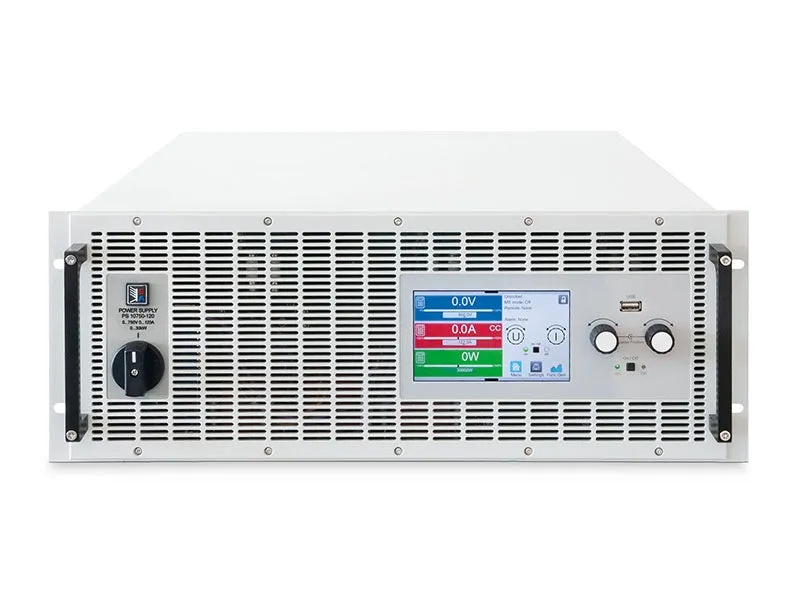
Elektro-Automatik EA-PSBE 10080-1000 4U Bidirektionales DC-Netzteil
Elektro-Automatik EA-PSBE 10080-1000 4U Bidirectional DC Power Supply
Angebot anfragen
Elektro-Automatik EA-PSBE 10080-1000 ist ein 30-kW-4U-Bidirektionales DC-Netzteil mit 0-80V/0-1000A-Ausgang, 94,6% Energierückgewinnung und umfassenden Konnektivitätsoptionen.
Produktdetails
| Modell | EA-PSBE 10080-1000 4U |
| Hersteller | Elektro-Automatik |
| Kategorie | Stromversorgungen und elektronische Lasten |
| Verfügbarkeit | Auf Anfrage |
Beschreibung
Übersicht
Das Elektro-Automatik EA-PSBE 10080-1000 ist ein bidirektionales DC-Labornetzgerät mit einer Leistung von 30 kW und einer Ausgangskapazität von 0-80V/0-1000A. Als Sparversion der PSB 10000-Serie kombiniert es umfassende Netzteil- und Elektroniklastfunktionalität mit einer Energierückgewinnung von 94,6% Wirkungsgrad, wobei volle Konnektivität und Steuerschnittstellen zu einem günstigeren Preis erhalten bleiben.
Hauptmerkmale
- Breiter AC-Versorgungsbereich: 342V-528V (380V, 400V oder 480V Netze)
- US-208V-Modelle verfügbar
- Bidirektionaler Betrieb: Netzteil und elektronische Last in einem Gerät
- Energierückgewinnungseffizienz: bis zu 94,6%
- Leistungsbewertung: 30 kW pro Einheit, erweiterbar auf 1920 kW mit Parallelbetrieb
- Spannungsbereich: 0-80V
- Strombereich: 0-1000A
- Flexible Autoranging-Leistungsregelung
- Umfassende Schutzschaltungen: OVP, OCP, OPP, OTP
- 5" TFT-Farb-Touchpanel mit Statusanzeige
- Fernwahrnehmung mit automatischer Erkennung
- Galvanisch isolierte Schnittstellen: USB, Ethernet, Analog, Erweiterungssteckplatz
- Optionale digitale Schnittstellenmodule (CAN, RS232, Profibus usw.)
- SCPI und ModBus Befehlssprachen
- LabVIEW VIs und Windows-Steuersoftware enthalten
Anwendungen
- Batterieprüfung und -Charakterisierung für Automobil- und Energiespeicher
- Leistungselektronik-Entwicklung und -Validierung
- Automobilisches Elektrosystem-Tests
- Industrielle Geräte- und Komponentenprüfung
- Forschungs- und Laboranwendungen
- Energierückgewinnung und Lastsimulation
Technische Daten
| AC Supply | All models are provided with an active Power Factor Correction (PFC) circuit and are designed for operation on a three-phase supply with typical worldwide ratings between 380 V and 480 V AC. But also regions where only 208 V three-phase is available are covered by the US 208 V models. During load operation, the device recovers the consumed DC energy and feeds it back into the local power network. This helps saving a lot of energy costs. |
| Autoranging Power Stage | All models are equipped with a flexible autoranging bidirectional power stage which provides a higher output voltage at lower output current or a higher output current at lower output voltage, always limited to the max. rated output power. The same applies for sink mode operation. The power set value is adjustable with these models. Therefore, a wide range of applications can already be covered by the use of just one unit. |
| DC Output/Input | DC voltages between 0...60 V and 0 ...2000 V, current ratings between 0...40 A and 0...1000 A are available, all along with a power rating of 0...30kW for all standard models, while the US 208 V models are rated with 0...15 kW. The DC terminal is located on the rear panel. |
| Source-Sink Operation | One salient feature of these devices is the coalescence of an electronic load, also called sink, and a power supply, also called source, into one unit. It means, the device cannot only arbitrarily operate as sink or source, the switchover between these two operating modes occurs without interruption and time loss. This is also called two-quadrants operation. |
| Energy Recovery | The most important feature of these devices is that the AC input while connected to the grid is also used as output for the recovery of the supplied DC energy during load operation, which is converted with an efficiency of up to 95.5%. This way of energy recovery helps to lower costs and can avoid expensive cooling systems, such as they are required for conventional electronic loads which only convert energy into heat. |
| Master-Slave | All models feature a digital master-slave bus by default. It can be used to connect up to 64 units of identical models in parallel operation to a bigger system with totals formation of the actual value of voltage, current and power. This allows for a total power of up to 1920 kilowatts. The configuration of the master-slave system is either completely done on the control panels of the units or by remote control via any of digital communication interfaces. Handling of the master unit is possibly by manual or remote control (any interface). |
| Display and Control Panel | Set values and actual values of input & output voltage / current / power are clearly represented on the 5" graphic display. The color TFT screen is touch sensitive and can be intuitively used to control all functions of the device with just a finger tip. Set values of voltage, current, power or resistance can be adjusted using the rotary knobs or entered directly via a numeric pad. To prevent unintentional operations, all operation controls can be locked. |
| Analog Interface | There is a galvanically isolated analog interface terminal, located on the rear of the device. It offers analog inputs to set voltage, current, power and resistance from 0...100% through control voltages of 0 V...10 V or 0 V...5 V. To monitor the output voltage and current, there are analog outputs with 0 V...10 V or 0 V...5 V. Also, several inputs and outputs are available for controlling and monitoring the device status. |
| Feature | Description |
| Product Type | DC Laboratory Power Supply |
| Rated Voltage and Range | 0...80 V |
| Insulation | Negative DC < - > PE: ±1500 V DC Positive DC < - > PE: +2000 V DC |
| Rated Current and Range | 0...240 A |
| Rated Power | 0...30 kW (0...15 kW) 4 |
| PSBE 10080-1000 4U | Rated Voltage and Range: 0...80 V Rated Current and Range: 0...1000 A Rated Power: 0...30 kW (0...15 kW) * |
Angebot anfragen
Elektro-Automatik EA-PSBE 10080-1000 4U Bidirektionales DC-Netzteil
Antwort innerhalb von 24 Stunden
Unverbindlich
Direkter Kontakt